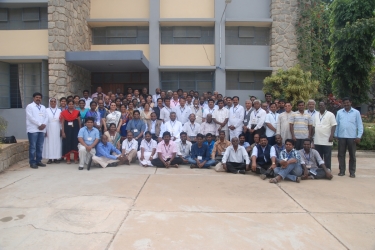
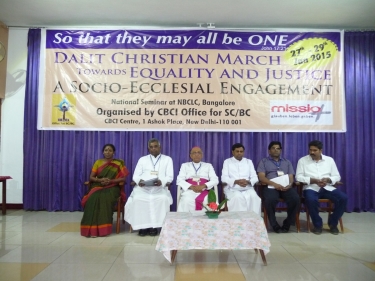
A three-day seminar was held on the topic, "So that they may all be one(Jn.17:21)- Dalit Christian March Towards Equality and Justice-A Socio-Ecclesial Engagement" at NBCLC, Bengaluru from 27 – 29th January 2015 organized by CBCI office for SC/BC, New Delhi where over 120 delegates from 11 states participated in a landmark gathering of sort in recent memory supporting the cause of the Dalits.
125 Participants from Andhra Pradesh, Telungana, Karnataka, Odisha, Kerala, Rajasthan, Delhi, Punjab, Maharashtra, Tamil Nadu, Jammu – Kashmir and from all over India gathered together in spirit and person for this seminar.
The inaugural session was presided over my Most Rev. Bernard Moras the Archbishop of Bangalore. He insisted that untouchability should be completely wiped out in the Catholic Church and he quoted the statement of CBCI General Assembly in Varanasi 1998 which stated that "discrimination against anybody on the basis of caste is a sin against God and humanity".
In his Keynote address Most Rev. Neethinathan the Chairperson of the CBCI Office for SC/BC and Bishop of Chengleput insisted that the mission of Jesus was for the poor and the marginalized and Church itself should come forward to render justice to the Dalit Christians.
Ms. Brinda Adige in her speech said that the Dalit Catholic women are slaves among slaves. As Dalit Catholic women their dignity and honor are exploited by others including the church.
The first National "Best Community Volunteer award" was given to Mr. Vijay Kumar Mothkuri for his volunteerism for the equality and empowerment of Dalit Christians.
Fr. Sagaya John the director of NBCLC stated that NBCLC took initiative by organizing a Convention of Christian Leaders on the Plight of Christians of Scheduled Caste Origin (CSCO) from 15th to 19th June, 1978, jointly with CBCI, the Catholic Union of India and the National Christian Council of India (NCCI).
Fr. Devasagayaraj, Secretary to the CBCI office for SC/BC while explaining the dynamics of the seminar said that the objectives of the seminar are to analyse and understand the status of the Dalit Christians within the Church and in the wider society; -to review the struggles of the Dalit Christians for dignity, rights and faith; to find ways and means to bring together Dalit leaders, priest and nuns as well as the other leaders of the Church to undertake seriously concrete programs of action for the emancipation of the Dalit Christians;- to arrive at concrete programs of actions based on this ecclesial and social engagement.
Rev. Dr. X.D Selvaraj presented a paper on "The Faith Struggles of Dalit Christians in the Indian Church". He said that untouchability is abolished by article 17 of the Indian Constitution and punishable under law and those who practice untouchability should be also punished canonically, since it is against faith and morals.
Dr. Maria Arul Raja spoke on "Dalit Empowerment through rereading Culture and history". He said that the culture of Dalits is communitarian liberation. Their culture is that of equality, love and sharing. We should continue to cultivate this aspect of communitarian liberation. Dalit culture also gives prominence to female deities hence their culture is to respect the honor and dignity of women. Their culture is not to enslave others and neither to yield themselves to be enslaved.
Most Rev. Derek Fernandes chairperson of SC/ST commission of Karnataka region and bishop of Karwar in his homily persuaded that the Dalits should continue their fight for justice without losing hope and the perseverance of fight strengthens the Dalits.
Fr. AXJ. Bosco sj spoke on Change of mind and heart, dreams of success. In his speech he clarified that the Caste system is the mind-set created by the hegemony of the dominant castes and it has been interiorised by Dalits over the past hundreds of years leading into inferiority complex. Dalits have to build up their own high self-image by self-suggestion.
Fr. S. Lourduswamy in his paper "Present situation of Dalit Christians" commented that the Dalits form 65 % of the total Catholics in India and the statements and the promises by the CBCI are yet to be realised. He insisted that Dalits should be recognised as a separate cultural people with in the Catholic Church.
In the panel on "Ghar Wapasi and Dalit Christians" Fr. Vijay Kumar Nayak accused that the Dalit Christians are reconverted to Hinduism by cohesion, enticement and allurement of Scheduled Caste status which promises them reservation, job opportunities, economic benefits.
Sr. Susila Mary on the "Year of Consecration in relation to Dalit women" exalted all the religious congregations to commit themselves to empower the Dalit Women with specific agenda and action plan.
Fr. Pitchaimuthu offered mass with Dalit music and said that the inculturation should be in the local language, music and tradition and inculturation should not be Brahminisation.
Most Rev. Soundararaju bishop of Vellore spoke on "Dalit Christian Emancipation -An Ecclesial and economic discourse". He insisted that each Dalit Christian should assert him/herself and come up in life. He quoted himself as an example how from a small poor Dalit village he was able to prove and assert himself and was able to become the principle of the same college where he studied and during his leadership period empowered many Dalit students by giving free education and they are all in good jobs now. He talked about the capital in the Catholic Church: one is the institutional capital and other is the leadership capital which are not in the hands of the Dalits though they are majority in the Catholic Church.
Rev. Dr. Prakash Louise with the help of the drafting committee headed by
Fr. Cosmon summed up the proposals, suggestions and action plans that emerged from the talks, group discussions and interventions. At the end of the seminar resolutions were made by the participants and suggestions were proposed to the Church and time bound concrete action plans were made which should be followed up with monitoring mechanisms.
In his concluding remark Most Rev. Neethinathan said that each one should commit oneself to create an equal and equitable church by abolishing all forms of untouchability and empowering the Dalit Christians.
Written by Fr. Devasagayaraj