

While Christians have welcomed the Supreme Court's decision upholding life imprisonment for Dara Singh, they have expressed disapproval at the court's remarks on forceful conversions.
On Friday, the Supreme Court upheld the life imprisonment for Dara Singh and Mahendra Hembram, both accused in the killing of Australian missionary Graham Staines and his two sons in Orissa's Koenjhar district in January 1999.
The bench of justices P Sathasivam and B S Chauhan rejected CBI's plea for death penalty to Singh saying that the crime did not fall under the rarest of rare category.
The Orissa High Court had in 2005 commuted Singh's death sentence, imposed by a sessions court, to life imprisonment. The CBI however sought the death sentence asking the Supreme Court not to conclude the case as a "simple conspiracy".
Two Christian bodies, the All India Christian Council (aicc) and the Global Council of Indian Christians (GCIC), welcomed the court's verdict upholding the life sentence.
"Most Indian Christians oppose the death penalty both on moral and theological grounds, as much as we oppose abortion and taking away life at any stage. Of course, as Christians, we want the State and Central government to uphold the rule of law," said the aicc Secretary General, Dr. John Dayal.
However, Dr. Dayal disapproved the comments of the Supreme Court on conversions by Christian missionaries.
"We do not want any court to pre-judge the matter of conversions and violence. The real root cause of strife in which Staines lost his life with his two kids was a misunderstanding of conversion. We have seen communal violence not only against Christians, but also on Muslims and Sikhs since India's Independence," Dayal said.
While delivering the verdict the court had observed that investigations reveal that Staines was involved in conversions and there are materials to suggest that missionaries were indulging in forceful conversion in the area.
"It is undisputed that there is no justification for interfering in someone's belief by way of 'use of force,' provocation, conversion, incitement or upon a flawed premise that one religion is better than the other," said the bench of justices.
In response, the aicc said inquiries by the National Commission for Minorities, Right To Information (RTI) requests, and other investigations have proven repeatedly there have been no fraudulent or forceful conversions by Christians in India anywhere, anytime. The Council might move Supreme Court to revise the reference at an appropriate time.
"We fear such remarks may negatively impact trials in Kandhamal, Orissa and future challenges to so-called 'freedom of religion laws' in various states," said Dayal.
Most Popular
-
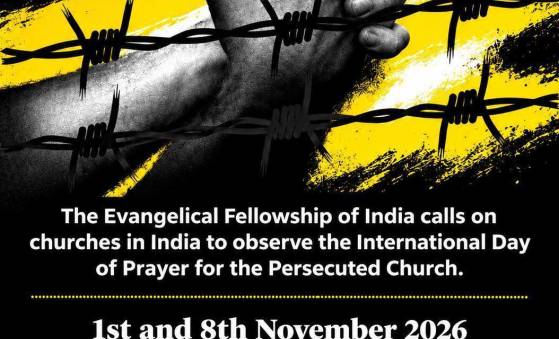
Evangelical Fellowship of India Calls Churches to Pray for Persecuted Christians on 1 and 8 November
-

A Hilltop Church in Kumaon Turns 94
-

Catholic priest and school principal seriously injured in attack by masked men in Jharkhand
-

Fresh Violence in Manipur Leaves Four Dead as Security Is Tightened
-

Myanmar Military Accused of Destroying Two Churches in Christian Regions