

What is conversion all about for which Christians are persecuted and crucified? The one alibi which is extensively used by fanatics to disturb prayer meetings, church assemblies and to drag pastors and preachers to police stations – a charge that is often accompanied by murders and burning alive of the 'accused'?
Religious animosity focused on alleged charges of forced 'conversion' has been witnessed in various states of this nation, though no evidence exists even for proving a single case.
Bible being the source book of all the activities of the missionaries, let us refer to the command of Jesus to His disciples to go into all the world and preach the good news. Every Christian, engaged in preaching, is only carrying out this command to be a witness. A perusal of the Bible will reveal while preaching is an activity of man, conversion is a process carried out by the Holy Spirit (also known as the Spirit of God) in the heart of the one who listens.
"Except ye be converted and become as little children, ye shall not enter into the kingdom of heaven," so reads Matthew 18:3. The aim of conversion goes beyond the change of religious labels; the aim is to make man more child like; to build up individuals as ideal members of society whose love for God gets translated into love for people and the public good. That is, conversion is the means by which values of equality, justice and righteousness are sought to the promoted; theologically this is building the kingdom of God in the place of kingdoms of this world.
God's new order is so radically different from everything we are accustomed to that we must be spiritually remade before we are ready and equipped to participate in it.
The assumption-- from the preaching of John the Baptist through Jesus to the first apostles –is that we are on the wrong path, moving away from God. The Bible refers to our self-determined course as walking in sin, darkness, blindness, dullness, sleep and hardness of heart. To convert is to make an about- face and take a new path.
To embrace His kingdom meant a radical change not only in outlook but in posture, not only in mind, but in heart, not only in world view but in behaviour, not only in thoughts but in action. In other words, a whole new beginning.
Conversion begins with repentance. Repentance turns us from sin, selfishness, darkness, idols, habits, bondages, and demons, both private and public. Having begun with repentance, conversion proceeds to faith. Repentance and faith form the two movements of conversion.
Faith is turning to belief, hope and trust. As repentance dealt with our past, faith opens up our future. We are converted to compassion, justice and peace as we take our stand as citizens of Christ's new order.
Conversion is from sin to salvation, from idols to God, from slavery to freedom, from injustice to justice, from guilt to forgiveness, from lies to truth, from darkness to light , from self to others, from death to life and much more.
As against these ideal goals, our present preoccupations can be summarily described as preoccupation with wealth, power, pride of self, pride of nation, sex, race, military might, etc. Conversion means a turning away from these reigning idolatries and turning back to the true worship of the living God.
The scriptures teach that evil is rooted not only in the human heart but also in the principalities and powers, in the structures of society. Personal sin is more visible to us than sin rooted in the system.
The caste system, corruption, racism, inequitable distribution of wealth, oppression of women and the weak, the arms race to which precious resources are diverted –each exemplifies a blindness that inevitably leads to poverty and misery of the masses. We have a fast growing middle class that has turned consumerist and indifferent to the lot of the masses of poor.
Again and again in the scriptures, the exploitation and the suffering of the poor is directly attributed to the substitution of the worship of mammon to the worship of God. Basil, the fourth century bishop of Caesarea, expressed his frustration on this point saying to the rich: 'How can I make you understand that your wealth comes from their weeping?' We don't understand that we have much more than we need because of the poor have much less than they need.
Transformed by God's love, the converted experience a change in all their relationships: to God, to their neighbour, to the world, to their possessions, to the poor and the dispossessed, to the violence around them, to the idols of their culture, to the false gods of the state, to their friends and to their enemies.
Conversion begins with individuals, but is for the sake of the world. The salvation of individuals and the fulfillment of the kingdom are intimately connected and are linked in the preaching of Jesus and the apostles. To be converted to Christ means to give one's allegiance to the kingdom, to enter into God's purposes for the world expressed in the language of the kingdom.
Conversion marks the birth of the movement out of a merely private existence into a public consciousness. No longer preoccupied with our private lives, we are engaged in a vocation for the world. Our prayer becomes, "Thy kingdom come, thy will be done on earth as it is in heaven."
Conversion then is a public responsibility –but public responsibility as defined by the kingdom, not by the state. Our own salvation, which began with a personal decision about Jesus Christ, becomes intimately linked with the fulfillment of the kingdom of God.
The Kingdom indeed represents a radical reversal for us. Aggrandizement, ambition and aggression are normal to our society and us. Money is the measure of respect, and power is the way to success. Competition is the character of most of our relationships, and violence is regularly sanctioned by our culture as the final means to solve our deepest conflicts.
Material goods have become a substitute for faith. John Chrysostom, the fourth century patriarch of Constantinople told the rich: 'You pretend to be serving God; but in reality you have submitted yourself to the hard and galling yoke of ruthless greed.' Today as then, material goods and wealth have assumed the place of ultimate concern, that is, the place of worship.
Eighteenth century English preachers deliberately linked revivalism to social change and proclaimed a gospel that was indeed good news to the poor, to the captives and the oppressed. Unfortunately, 20th century evangelicalism in the US came to identify thoroughly with the mainstream values of wealth and power. No wonder the influence spreads to other poor nations.
The Biblical doctrine of stewardship renders a clear judgement against any economic system based on ever expanding growth, profit and exploitation of the earth
Jesus identified himself with the weak, the outcaste and the downtrodden. One could not profess love for God while ignoring the needs of hungry neighbours. To trust fully in God requires not only that we break our attachment to possessions, but also that we identify ourselves with the poor and the afflicted in their distress.
Conversion means to relinquish our wealth, for the sake of our relationship with God and for the sake of our relationship with the poor. Justice requires an end to our accumulation.
The Sermon on the Mountâ€"perhaps the greatest sermon that had influenced third world leaders like Gandhiji giving them a taste of the kingdom described in the Bible, offers a way of life contrary to what we are accustomed. It overturns our assumptions of what is normal, reasonable and responsible.
The result of such influences produced a Gandhi, a Mother Teresa, a Baba Amte, a Nelson Mandela or a Bishop Tutu. The outflow of Christian love manifested in humanitarian works among the poor by way of good schools and hospitals and orphanages, and gave a push to ideals of justice, righteousness and equality in many societies.
The central text of the Christian faith, the Bible, has influenced the world more than any other book written by man. Of its role, one writer has stated thus: " That the truths of the Bible have the power of awakening an intense moral feeling in every human being; that they make bad men good, and send a pulse of healthful feeling through all the domestic, civil and social relations; that they teach men to love right and hate wrong, and seek each other's welfare as children of a common parent; that they control the baleful passions of the heart, and thus make men proficient in self government; and finally that they teach man to aspire after conformity to a being of infinite holiness and fill him with hopes more purifying, exalted, and suited to his nature than any other book the world has ever known –these are facts as incontrovertible as the laws of philosophy , or the demonstrations of mathematics." (F Wayland)
Most Popular
-
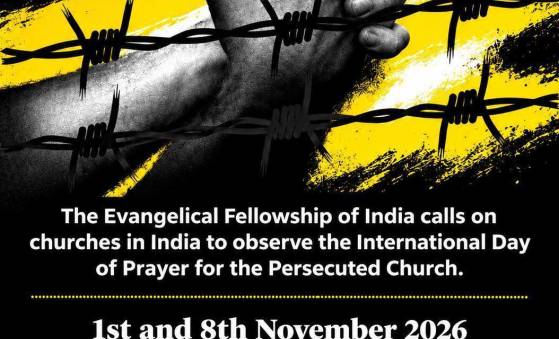
Evangelical Fellowship of India Calls Churches to Pray for Persecuted Christians on 1 and 8 November
-

A Hilltop Church in Kumaon Turns 94
-

Catholic priest and school principal seriously injured in attack by masked men in Jharkhand
-

Fresh Violence in Manipur Leaves Four Dead as Security Is Tightened
-

Myanmar Military Accused of Destroying Two Churches in Christian Regions