

At a time when Nagpur, the head quarters of National Council of Churches in India (NCCI) was sizzling at forty-five degrees centigrade, showers of rain and cool breeze surmounted the meeting of Dalit coordinators of member Churches of NCCI, which was held at Ecumenical Resource Center, United Theological College, Bangalore during 21-23 April 2010.
The need and importance of a network among Churches for the work of Dalit solidarity was felt and discussed by the participants. To that effect, a National Ecumenical Dalit Solidarity Network (NEDSN) emerged out of the deliberations with an objective for common witness and for mutual sharing of the local accompaniments with Dalit struggles.
35 participants from members Churches of NCCI attended this meeting and expressed their commitment in networking with other Churches, with theological fraternity and with other liberation social movements.
As a beginning in making the network operational, it was agreed by the participants to join in the campaign to eliminate manual scavenging by 2010, to join in the campaign for justice to Christians and Muslims of Dalit origin and to join in observing the Dalit liberation Sunday on 5th December 2010.
The participants volunteered themselves to be the reference persons in their churches in disseminating the concerns of the NCCI at the local congregational levels, and also to project the local issues to the national council.
The need for a separate secretariat for Dalit concerns in their respective Churches was felt, and the participants of this meeting expressed that they would impress upon their leadership in forming such a desk to carry forward the mandate of Dalit liberation in their Churches. It was reiterated that networks among Churches are an extension to hospitality and an invitation to taking risks for the sake of common good.
The meeting was inaugurated by Mr. Angelious Michael, Vice President of NCCI, and has emphasized that in this age of networks, as Churches to network for Dalit solidarity is the need of the hour.
At the inaugural session, the participants spent a minute of silence in honour of Dr. K. Rajaratnam, the former President of NCCI and the former Chairperson of Commission on Dalits & Adivasis and gave thanks for his life, witness and contributions for the Dalit solidarity.
Rev. Asir Ebenezer, the Officiating General Secretary of NCCI delivered the keynote address and explained, "the network among Churches towards Dalit solidarity is not a set up, is not a project but a function and a process aimed towards a common witness by consolidation the agenda of Dalit liberation."
Dr. Moses Manohar, Executive Director of ICSA spoke on the theme, " Political Activism: Directions for Networking", while Dr. David Selvaraj, Director VISTHAR, made a creative and participatory workshop on "Weaving Methodologies for Networking".
Rev. Dr. Evangeline Rajkumar, Professor, UTC spoke on the "Theology of Networking." Mr. Paul Divakar, General Secretary of NCDHR spoke on "Dalit Networking: Perspectives of Movements and Projections to Churches" and Rev. Dr. Deenabandhu Manchala, Programme Executive of the World Council of Churches, delivered his talk on " Global perspectives of Dalit Networking."
The network among Churches for Dalit solidarity is basically for a confederation of Dalit activists within the Churches, to consolidate the common agenda for a common witness and to conscentise the Churches with local and national concerns of Dalits, for today the Dalit agenda is the core mission agenda of the Churches in India. Prayerfully the NEDSN was launched, and each of the participants expressed their hope in making a difference for Dalit solidarity through this network.
Most Popular
-
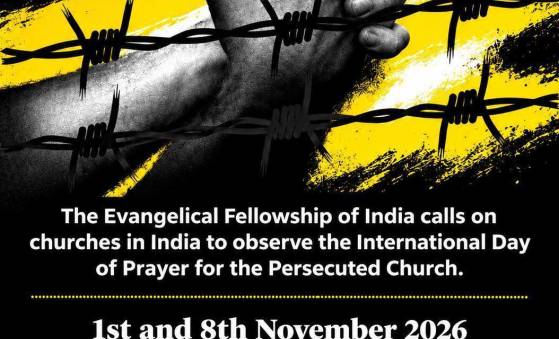
Evangelical Fellowship of India Calls Churches to Pray for Persecuted Christians on 1 and 8 November
-

A Hilltop Church in Kumaon Turns 94
-
Catholic priest and school principal seriously injured in attack by masked men in Jharkhand
-
Fresh Violence in Manipur Leaves Four Dead as Security Is Tightened
-

Myanmar Military Accused of Destroying Two Churches in Christian Regions