

In a clear indication of people's yearning for 'secularism' over 'communalism', the upshot of the 2009 general elections, successfully placed Congress-led UPA in the lead, once again discomfiting the Hindu nationalist Bharatiya Janata Party (BJP).
The latest trends showed Congress claiming near majority in the 545-seat Lok Sabha, which further infers that Manmohan Singh will remain the Indian Prime Minister for the next five years.
For the Christian community, the elections were of paramount importance against the backdrop of recent attacks on churches and missionaries across the country.
The General Secretary of the National Council of Churches in India (NCCI), Bishop DK Sahu, told Christian Today, he was greatly elated by the outcome of the elections, after people voted out the non-secular parties.
He heaved sigh of relief that those responsible for the Kandhamal violence and condemnable atrocities on Christians were ostensibly given a 'red' signal to lead the nation.
"They should lead (Congress). Our prayers have been answered," he said.
"Christians wanted a secular government, and it is a very positive sign that Congress won the elections. But, however, the question remains: Will the government deliver results?"
He hopes that the new government will work assiduously to deliver good governance and effective administration, and predominantly the enhanced security of minorities.
The state of Orissa which was rocked by communal and sectarian violence on Christians, last year, says Bishop Sahu, has voted sensibly by giving no room for communal parties.
"The BJP has been completely wiped out of Orissa," he said, adding "Christians in Kandhamal are jubilant and there is still a sign of hope for them."
Last year, in the aftermath of the murder of Swami Laxmananda Saraswati, Hindu extremists accused Christians for the slaying, and caused great havoc that wholly paralyzed the community. 50,000 were rendered homeless and 4,640 houses, 252 churches and 13 educational institutions were destroyed.
Bishop Sahu sharply criticized the BJP for its divisive politics and 'Hindutva' ideology, and said, "We Christians are part of this country and are no outsiders. So we will remain as part of India and continue to involve in the development of this country."
Before the elections began on April 17, NCCI that represents over 13 million Christians in India, along with the Catholic Bishops' Conference and other church groups, released statements that urged the electorate to vote for a party or candidate who is committed to "secularism and communal harmony".
The Christian leaders pleaded to politicians to "address the issues of the nation holistically and not based on religion, which can cause communal disharmony."
John Dayal, Secretary General of All India Christian Council, has also welcomed people's rejection of communal parties and said "this is an golden chance in the history, where people are expecting a secular government to look after the needs of the country."
Some 713 million Indians were eligible to vote this year. There were total 8,070 contestants, including 556 women in the fray. According to the constitution, a new government must be formed by June 2.
Most Popular
-
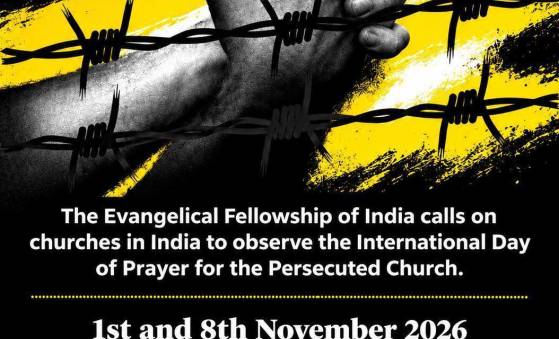
Evangelical Fellowship of India Calls Churches to Pray for Persecuted Christians on 1 and 8 November
-

A Hilltop Church in Kumaon Turns 94
-

Catholic priest and school principal seriously injured in attack by masked men in Jharkhand
-

Fresh Violence in Manipur Leaves Four Dead as Security Is Tightened
-

Myanmar Military Accused of Destroying Two Churches in Christian Regions