

The Cross and Resurrection are the central themes of Christianity. What do they mean? How are they relevant in our lives? To understand the meaning of the Cross and Resurrection, we have to look deeply at the love Jesus revealed to us. When we speak about Jesus, we speak about His love. What is this love that Jesus has revealed to us?
It is difficult to explain love without thinking about Jesus. Jesus is love personified. Jesus was the Messiah, the Savior the Jews were waiting for. Jesus was the Messiah promised by God, prophesied by the prophets.
Who were the Jews? They were the promised children of God. They were the ones Jesus loved and came to this world for. They were His own people. But they were the ones who rejected Jesus, scorned Him, mocked Him and even tried to kill Him. In spite of everything, Jesus did not avoid the way of the Cross, nor did He love towards His people change.
What killed Jesus? It is the sins of the Jews that crucified Jesus. The sins of distrust, the sins of disbelief. "You diligently study the Scriptures because you think that by them you possess eternal life. These are the Scriptures that testify about me, yet you refuse to come to me to have life." (John 5:39–40)
The Lord poured out all His love for the promised people, the Jews, and, yet, they rejected Him and remaining indifferent and cold to His sufferings. The arrogance of the Jews, the Pharisees and the chief priests, made them blind to the Truth – "If you were blind, you would not be guilty of sin; but now that you claim you can see, your guilt remains." (John 9:41) Their distrust and disbelief made them shun the Lord – "Where did this man get these things?" they asked. "What's this wisdom that has been given him, that he even does miracles! Isn't this the carpenter? Isn't this Mary's son and the brother of James, Joseph, Judas and Simon? Aren't his sisters here with us?" And they took offense at him. (Mark 6:2–3) Their jealousy and envy made them conspire and plot to trap and kill the Lord – "But when the chief priests and the teachers of the law saw the wonderful things he did and the children shouting in the temple area, "Hosanna to the Son of David," they were indignant." (Matthew 21:15)
Indeed, the sins of the people crucified Jesus. The ones who welcomed the Lord when He entered Jerusalem riding on a donkey, with shouts of "Hosanna, Hosanna" were the ones who cursed and rebuked Him as He carried the Cross to Golgotha. How distorted and darkened their hearts were? The same sins are inside of us.
What do the Cross and Resurrection symbolize? Why are they central to a believer's faith? To understand this, we have to understand what the Cross symbolized in the days of Jesus. In the times of Jesus, only the worst of the criminals were condemned to be crucified or 'hung on a tree' as people regarded them as accursed. But, by being crucified Himself, Christ redeemed us from the shadow of death; He redeemed us from eternal death and freed us from our sins by becoming a curse for us. Jesus – the little Lamb of God – carried our sins to the Cross just as a scapegoat carried the sins of the Israelites out to the desert, to be mauled and devoured by the wild animals (See Leviticus 16: 20–22).
The words of prophet Isaiah succinctly explains the meaning of the Lord's crucifixion:
"Surely he took up our infirmities
and carried our sorrows,
yet we considered him stricken by God,
smitten by him, and afflicted.
But he was pierced for our transgressions,
he was crushed for our iniquities;
the punishment that brought us peace was upon him,
and by his wounds we are healed.
We all, like sheep, have gone astray,
each of us has turned to his own way;
and the LORD has laid on him
the iniquity of us all.
He was oppressed and afflicted,
yet he did not open his mouth;
he was led like a lamb to the slaughter,
and as a sheep before her shearers is silent,
so he did not open his mouth.
By oppression and judgment he was taken away.
And who can speak of his descendants?
For he was cut off from the land of the living;
for the transgression of my people he was stricken.
He was assigned a grave with the wicked,
and with the rich in his death,
though he had done no violence,
nor was any deceit in his mouth." (Isaiah 53:4–9)
Because of our sins, Jesus died. He carried the burden of our sins instead of us to the Cross. Like the Israelites who confessed all their sins and put them on the goat's head, we have also imputed all our sins on the little Lamb of God. Our sins have nailed Jesus to the Cross. He has become the scapegoat for all our sins. Through His blood, we have been redeemed from the sentence of death. The Cross, the symbol of death and curse, is now the symbol of His immeasurable love for us and His sacrifice. The Cross, the symbol of death, defeat and failure, is now the symbol of victory and triumph – in His death, Jesus has triumphed over death. Death was the last obstacle that lay in the path of Jesus. Jesus went through unspeakable pain, suffering and humiliation at the hands of the Jews, at the hands of those He loved, yet, nothing could change His love for them, for us. Death was the last thing that stood in His way, which could have blocked His love for us. Yet, even death could not prevent Him from pouring out His unconditional and selfless love for us. Death could not stand between Lord Jesus and the ones He loved. Death could not stand between His love and us. In death, Lord Jesus has overcome the world. In His death, He won. Rightly, in the words of Apostle Paul, "Death has been swallowed up in victory." (1 Corinthians 15:54) Jesus swallowed death in victory. His love swallowed even death. How great was His love for the sinners, for those who rejected, scorned, mocked, scourged and crucified Him?
The cursed Cross of death, the cursed Cross of suffering and failure has been transformed into the Cross of love and sacrifice. Like the sacrificial lamb, like the scapegoat, His body was torn apart for us, He spilled His blood for us, His sacrifice and love for us redeemed us from eternal death and gave us new life. Jesus died on the Cross instead of us. He died on the Cross in our place. He took up the sentence of death in our place. He gave up His blood, His love, His life; He gave up everything He had for us so that we may be redeemed from the curse of death, from the curse of the Cross and we may live. His death on the Cross is the ultimate and complete expression of His love for us. In His death, He overcame the evils, the sins of this world, He carried our sins and revealed that nothing, not even death could stand in His way of loving us. Through Him, we could receive new life and become whole and complete again, we could live newly. The Cross, thus, did not become the end, but became the beginning of a new life. Through the Cross, all our sins were washed away and we could live and walk newly again, opening our eyes to a new world.
What is resurrection? It is that Jesus is not the one to be confined in the tomb of death and despair. He lives again. He rises again. Just as death on the Cross could not stop Him from loving us, the tomb could not confine Him from resurrecting in us, in our lives.
Good Friday and Easter Sunday commemorate the crucifixion and the resurrection of Jesus. As Christians, if we are to walk the way Jesus walked, if we wish to walk together with Jesus, we have to first know the way He walked, the path He took. In every step of our walk of faith, in every moment of our lives, we should try to resemble the image of our Lord. Remembering the Living Lord Who overcame hatred and jealousy, Who overcame the pains and the sufferings of this world, Who without any inhibition, gave up everything, even His own life for us, Who through His death, overcame the powers of darkness and despair and freed us from the chains of sin and the sentence of death, let us be the ones who can truly become the messengers of His selfless love, following not the desires of the flesh, but, like Jesus, following the desires of the spirit.
As Christians, we are not perfect, not righteous. But every moment, we are walking towards the perfection and righteousness that is Lord Jesus. Every moment, we are learning to be a better person, a better Christian, and, in the process, revealing the deep love of the Lord. Amen.
Most Popular
-
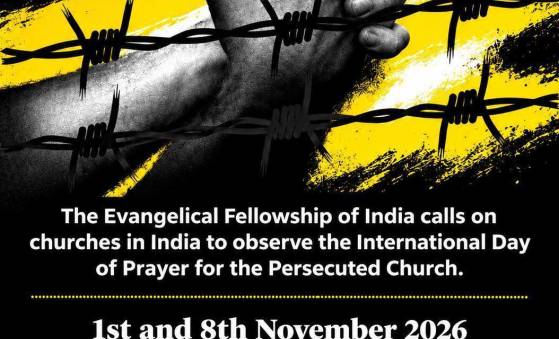
Evangelical Fellowship of India Calls Churches to Pray for Persecuted Christians on 1 and 8 November
-

A Hilltop Church in Kumaon Turns 94
-

Catholic priest and school principal seriously injured in attack by masked men in Jharkhand
-

Fresh Violence in Manipur Leaves Four Dead as Security Is Tightened
-

Myanmar Military Accused of Destroying Two Churches in Christian Regions