

Our Lord teaches us not to hate. We do not hate our enemies.
But Fear is real, especially in Orissa's Kandhamal district.
It is not just Kandhamal, or indeed Orissa. Unfortunately, circumstances in India are such that the religious minorities and the marginalised groups, the Dalits and others, have to live under the shadow of fear, of violence and domination, hate and official impunity, always looking over the shoulder for the next threat. Priests in forest parishes, pastors in villages, evangelists in distant rural areas, and social activists live under a very real and very dark shadow of fear.
On 23rd August 2008, Lakhmanananda Saraswati, the vice-president of the Vishwa Hindu Parishad (VHP), was shot dead in Kandhamal, Orissa, a local group of the Left extreme Maoists claiming credit for killing man they held to be guilty of many anti-people activities in the region. His body was taken around in a day long procession through Kandhamal's forest villages and townships by the VHP leaders as the police provided help, or just looked on. The violence followed in its wake, as surely as anti-Muslim violence had followed in the wake of Lal Krishna Advani's notorious Yatra 20 years earlier or the anti-Muslim pogrom erupted in Gujarat after the bodies of people burnt in the Sabarmati Express in February 2002 in Godhra railway station in the state. As in Gujarat, the State looked on, many of its agencies almost abetting the violence by acts of omission and commission. The parallels with Gujarat 2002 continue.
In Kandhamal a year after that dreadful day of 24th August 2008, the situation remains terrible.
We know for a fact that perhaps as many as 20,000 [of the 50,000 who were rendered homeless when almost 5,000 houses were torched by Hindutva mobs] remain internally displaced persons, living as refugees or beggars in other towns of Orissa and in nearby states, some even in Mumbai and New Delhi. Some live in Christian ghettos created by the government which could not protect them in their home villages.
We know that so called fast track courts of the Orissa government have set free known killers because the police did not prepare a sound case and because the state failed to protect witnesses who were threatened and who could not give evidence. We know that government has reneged in its promise of financial relief and rehabilitation of widows and other victims of the violence. We also know to our deep regret how even so called judicial commissions headed by retired High Court judges have tried to pin blame on Christians citing conversions as the main cause of violence without even trying to identify the perpetrators of murderous violence.
The threat is potent enough for many Christians to prefer to live in government refugee camps in ghastly conditions because the killers roam scot free in their home villages while the police look on. All this has been documented not just by me since the first spark of 24th December 2007, but by the international media, and by noted Indian Christian investigative reporters such as Anto Akkara and Vishal Arora. Independent scholars Professor Angana Chatterji of California, and Prof Manoranjan Mohanty and Advocate Vrinda Grover, both of New Delhi have documented this. Even the National Minorities Commission has commented on it. And of course the Church and its Human Rights activists continue to raise the issue with the National and State governments. The uneasy peace is maintained by armed police whose energies have however been diverted to cope with Maoist militant activity in this region and other states.
The main threat continues to be from Hindutva elements who have tasted blood and who have prospered and flourished under official patronage. Many of them are now joining the ruling party, the Biju Janata Dal (BJD). The police and administration is also heavily infiltrated by these elements. The lack of a witness programme and the involvement of crucial police officers prevent real investigation and ensure a miscarriage of justice. We await superior court judgments to petitions that these criminal cases be tried outside Kandhamal and outside Orissa so that witness protection programmes can be put into place. .Official impunity, the tacit support to Hindutva, and increasing polarisation do not augur well for religious minorities.
But this is our homeland, and we will remain, even if the struggle for justice has to continue indefinitely. It is the state's duty to end violence, a duty it must carry out. We are before the Supreme Court for this, as also before the President of India. We also know that the international human rights community is watching India.
For the Christians of Orissa and of Kandhamal in particular, there is the strength of faith which prevents the fear from becoming a routing or crippling paralysis. Even in the darkest hour of violence in Orissa a year ago, the people refused to abandon their faith, and that is where they conquered fear of that sort.
As for reconciliation, most of us have been working for reconciliation and peace. Not reconciliation as a compromise, or as a sign of defeat; not reconciliation as surrender; but reconciliation born out of forgiveness and underpinned by justice ensured by the state. Murderers and killers, who did the violence out of ideologies of hate and mischief, need to be punished, but communities need to get over the suspicion and hate and come together once more.
Time is ripe for genuine reconciliation in Orissa and elsewhere, if the State were to take a few small steps.
Most Popular
-
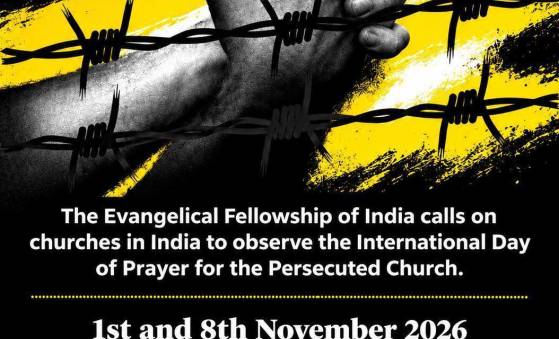
Evangelical Fellowship of India Calls Churches to Pray for Persecuted Christians on 1 and 8 November
-

A Hilltop Church in Kumaon Turns 94
-

Catholic priest and school principal seriously injured in attack by masked men in Jharkhand
-
Fresh Violence in Manipur Leaves Four Dead as Security Is Tightened
-

Myanmar Military Accused of Destroying Two Churches in Christian Regions