

Chicago, USA – Not only did the tsunami drown southern Asia; it challenged its soul.
When the waves washed over India's coastal villages Sunday, thousands of pilgrims to a Marian shrine were washed away while paying homage and attending mass.
Bodies were scattered and buried in the sand, and the shrine suddenly became a morgue.
University of Chicago divinity student Kristin Bloomer, who had been studying Indian devotion to Mary, said she watched as one man shouted: "There is nothing! There is nothing! Where is God? What is God?" Then he burst into tears, hung his head and wept.
While not all faiths can provide an explanation for why such devastating disasters happen, scholars say each of the four major religions in the region – Islam, Buddhism, Hinduism and Christianity – possesses a distinct theology that eventually will help people put the calamity in perspective and move forward in its wake.
But it will take time, they say, for survivors to reclaim their lives and recover their faith.
"It does require spiritual resources that people of all faiths draw upon," said Diana Eck, a professor of comparative religion and Indian studies at Harvard Divinity School. "What one's faith gives you is the capacity to respond to a disaster, not necessarily to explain it."
For now, the immediate need is for food, shelter and protection from disease that threatens to claim more lives. Bloomer, who has been unearthing bodies from the sand to bury or burn, said by cell phone that the priests beside her have spent more time digging for the dead than counseling survivors.
Many devotees believe that their response to the catastrophe is a measure of piety.
"Events of this type are supposed to reopen the eyes of a believer," said Kareem Irfan, chairman of the Council of Islamic Organizations of Greater Chicago. "Part of the test of life is dealing with suffering, how you react to suffering and how you help others out."
That inclination to help also exists within Christianity and in the Hindu and Buddhist concepts of dharma, or community.
"We try to keep our minds stronger to see and try to serve those who survived, those who lost their families, their relatives," said Ratana Thongkrajai, a Buddhist monk from Thailand with the Wat Phrasriratanamahadhatu Temple in Chicago. "We try to support them. Sitting and crying and sad, how we can support them? We try to give a good thing, to share with them."
"The need of the hour is what's practical," said Matthew Kapstein, a visiting professor who specializes in Indian Buddhist philosophy at the University of Chicago Divinity School. The cataclysm could be an opportunity for monasteries to become havens for healing, he said. "That for most people is going to count for a lot more than any particular theological explanation."
Still, in the face of such devastation, victims are likely to be asking the big question: Why did this happen?
"Everybody has access to scientific explanations about tectonics," said Wendy Doniger, an expert in Hindu mythology at the University of Chicago Divinity School. "Why should this be a natural calamity in your own life? That's what people care about."
Among the major religions in the affected area, Muslims and Christians are generally able to draw from the belief that a natural disaster is part of a divine plan beyond human comprehension. Hindus and Buddhists, meanwhile, do not ascribe it to a divine plan but encourage devotees to let go and accept the ever–changing state of the universe and role of suffering in the human experience.
But in the Theravada Buddhist tradition most prevalent in Sri Lanka and Thailand, the doctrine of the eight–fold path – intended to help people cut off individual suffering – may do little to treat pain of such massive proportion.
"The usual kinds of question that humans ask – `Why me?' – is overwhelmed by the question of `Why us?''' said Charles Hallisey, a leading scholar of Theravada Buddhism at the University of Wisconsin in Madison. "I don't think anyone in this situation is going to have a ready answer."
In Hindu theology, the theories for why disasters like the tsunami occur are varied. Some attribute the destruction to the same deities that control childbirth and fertility, illustrating that those who create also destroy. Others subscribe to the Hindu concept of honi, the theory that undeserved catastrophes – when bad things happen to good people – is not karma catching up with them, but inexplicable events that just happen.
"It is a natural event. We cannot do anything about it," said Krishna Rajan, a priest at the Hindu Temple of Greater Chicago in Lemont. "Hold onto the god and hold onto the feet of the lord. He will give you the strength to go through what you have to go through."
But some Buddhists do accredit humankind's collective past deeds with destabilizing the universe and leading to disaster.
"Rather than speaking an answer in a deity out there, the response that is at least counseled in Buddhist thought is to consider the unsatisfactoriness of the world and our patterns of behavior that have contributed," Kapstein said.
Hallisey hesitates to assign blame, as people in the region do not need the added grief of feeling responsible. "It goes beyond what people are normally used to explaining," he said. "That, I think, is part of the continuing tragedy."
Edmund Chia, a professor of Asian theologies at Catholic Theological Union who has worked in Malaysia and Thailand, said what is important is "to try to promote life, to assist, reach out and be there." That in itself can help put the event in perspective, he said.
"A lot of these natural phenomenon are beyond our finite minds to understand," he said.
Some evangelical Christians believe the great waves are "birth pangs" leading up to the Rapture, in which Christian believers will be swept up to heaven by Christ before judgement is rendered on those left behind.
Todd Strandberg, founder of Raptureready.com, a Web site dedicated to documenting the fulfillment of the Biblical prophecy of the "end times," said the tsunami should cause people to evaluate their lives.
"To have all those people die shows us that we have got the gift of life and a limited time here on earth," he said. "I think that's why disasters occur.
He wants to remind us that we have a limited time on earth. And the survivors should take note of that."
Some Muslims also will attribute the disaster to divine plan, experts said. Though it may be difficult, believers are expected as soon as possible to recognize and submit to the majesty of God without losing sight of his compassion and mercy.
"Everything comes from God, which, of course, is very difficult to encompass in the face of such a random catastrophic event when the victims are the weak and the poor," said Marcia Hermansen, a professor of Islamic studies at Loyola University. "It's not like you blame God or lose your faith. In the larger scope of things, one is patient and realizes that life is not ultimate."
In India, Bloomer said she feels it is too soon to tell what the disaster's impact will be on individuals' faith.
"People will have their very human reactions," she said. "That includes getting angry at God or gods depending on your belief systems.
"Lives are so unpredictable," she added. "About as unpredictable as what happened this time."
Most Popular
-
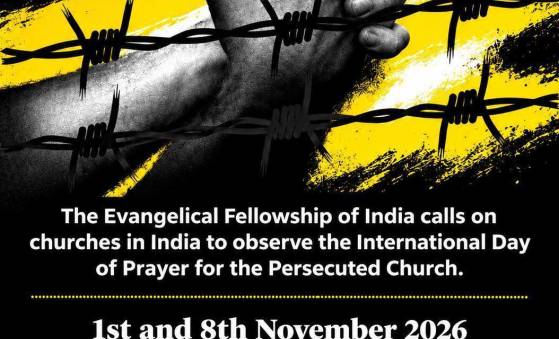
Evangelical Fellowship of India Calls Churches to Pray for Persecuted Christians on 1 and 8 November
-

A Hilltop Church in Kumaon Turns 94
-

Catholic priest and school principal seriously injured in attack by masked men in Jharkhand
-
Fresh Violence in Manipur Leaves Four Dead as Security Is Tightened
-

Myanmar Military Accused of Destroying Two Churches in Christian Regions