

Busan, South Korea – Bishops of neighboring nations of Japan and Korea gathered for the 10th Japanese and Korean Bishops' Interchange Meeting to share their history and their pastoral efforts.
During the 3–day meeting held on Jeju island in November, the church leaders discussed on diverse issues that, according to news reports, have deepened their understanding and thoughts.
"Frequent meeting means deepening understanding and mutual discussion. This bishops' meeting is a good place where bishops from the two nations can freely discuss the past history of Korea and Japan," Bishop Vincent Ri Pyung–ho of Chonju, South Korea, said.
"For 10 years the range of understanding has deepened and we can share our thoughts more frankly," he added.
Bishop Ri said Korea and Japan have a history colored by invasions and occupation, with Japan as the aggressor. He acknowledged that hard feelings remain due to the Japanese colonization of Korea from 1910 to 1945.
"We have discussed historical issues including distorted history textbooks during the meetings, and the ongoing dialogue makes it easy to talk more freely about history–related issues. As Catholics, we will also focus on exchanges of pastoral information," he reported.
The annual meetings were proposed by Archbishop Paul Ri Moun–hi of Taegu and Bishop Peter Kang U–il of Cheju (Jeju) 10 years ago to develop a common understanding of the history of Korea and Japan, and to promote friendship among the two countries' bishops. Both Korean bishops took part this year.
As a result of the meetings, the Korean edition of "Primer of Korean History that Koreans and Japanese Read Together, Close and Closer" was published in April 2004. A Japanese edition has not yet been prepared.
The meetings are not an episcopal conference–level interchange, but a meeting to promote friendship between Korean and Japanese bishops, explained Father Paul Lee Chang–young, undersecretary of the Catholic Bishops' Conference of Korea.
"The main theme of the bishops' meeting is to learn each other's history. Bishops will study the history of Jeju Island and how the colonization of Korea by Japanese imperialists affected it," Father Lee said. Jeju was selected as the venue to highlight that the island, generally known only for tourist attractions, also has a Catholic shrine and history, he said.
The 13 Japanese bishops who took part in the meeting included Bishop Augustine Nomura Junichi of Nagoya, president of the Catholic Bishops' Conference of Japan; Archbishop Peter Okada Takeo of Tokyo, vice president of the conference; and Archbishop Joseph Takami Mitsuaki of Nagasaki.
From South Korea 18 bishops took part including Cardinal Stephen Kim Sou–hwan, retired archbishop of Seoul, and Archbishop Andrew Choi Chang–mou of Kwangju, president of the Korean bishops' conference.
Archbishop Leo Ikenaga Jun of Osaka, Japan, said that the meeting was helpful for mutual understanding. "It's good to have friendly communication with Korean bishops. We shared our views on historical issues and pastoral information including youth ministry," he said. "Although it's difficult to grasp real facts on the historical issues since they happened long ago, it's important for us to have a sharing of history," he added.
At the reception held on November 16 at Travelers Hotel in Jeju island, Cardinal Kim said he welcomed the opportunity that might not come again for him. "I'm trying to participate in this meeting with the thought that this will be the last time. I'm trying to learn more while I can still move," he said.
"During the 10–year interchange, we promoted our friendship and deepened our reliance. I hope we deepen our brotherly love more and return with rejoicing," the 82–year–old Korean cardinal told the other participants.
Archbishop Ri expressed his confidence that the meetings would continue longer than he originally envisioned. "It's God's grace that we can meet in one place leaving out the differences of languages, thoughts and cultures. At first, I intended to hold these meetings just for 10 years. Now, I'm sure they will not be stopped, since we have developed friendships and need to meet and talk," he said.
On the first day the bishops visited Chungang Cathedral and two important sites related to Catholic history on the island.
At Hwangsapyeong, where some early Catholics who died during the Jeju People's Uprising in 1901 were buried, the bishops offered floral wreaths and prayed for the souls of the victims. They also visited Gwandeokjeong, where other casualties of the uprising were buried.
The uprising, a local rebellion against feudalism and colonialism on the island, left 700 Catholics dead at Gwandeokjeong. Of these, 28 were buried at Hwangsapyeong, which is now a public cemetery for Catholics. Some were buried privately by their families.
At Chungang Cathedral about 200 parishioners, Jeju Governor Kim Tae–whan among them, gathered to welcome the bishops. During the welcoming ceremony, Bishop Nagoya said: "Exchanges between the two nations are increasing. It's meaningful that the Catholic Churches of Korea and Japan are leading the interchange."
According to Bishop Nomura, many Japanese currently enjoy Korean TV drama series and are trying to learn Korean culture and language as part of the so–called "Korean wave" in Japan. "I hope these are not just passing phenomena, and that they will help enhance mutual understanding and make us good neighbors," the Japanese bishops' conference president said.
On the second day of the meeting, the bishops listened to a lecture on Jeju Island's history and concelebrated Mass at Seogwipo Parish. Afterward, they exchanged pastoral information on Cheju diocese and Kyoto diocese in Japan.
The next meeting is scheduled for November 18–20, 2005, in Japan, though the specific site has yet to be determined.
Cheju diocese had 58,512 parishioners in 23 parishes and 11 mission stations served by 37 priests at the end of 2003, according to Korean Church data.
Most Popular
-
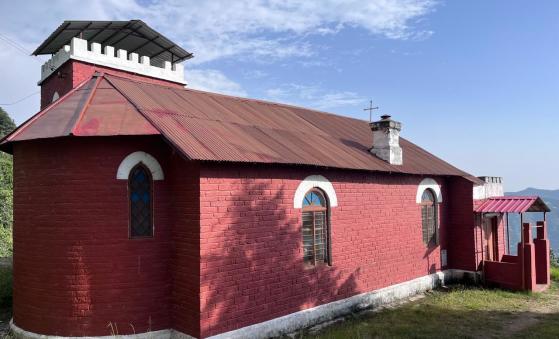
A Hilltop Church in Kumaon Turns 94
-
Evangelical Fellowship of India Calls Churches to Pray for Persecuted Christians on 1 and 8 November
-
Catholic priest and school principal seriously injured in attack by masked men in Jharkhand
-
Fresh Violence in Manipur Leaves Four Dead as Security Is Tightened
-
Jesuit Deacon’s Ordination Postponed Amid Questions Over Conversion Records